

Agentic AI in Power Platform and Dynamics 365: More than traditional Copilot
For the past few years, Microsoft’s AI journey has been centered around Copilot as an intelligent assistant. With the latest Power Platform and Dynamics 365 releases, we are witnessing a significant transition from AI assistants to AI agents capable of reasoning, planning, and executing tasks across business applications. [microsoft.com], [learn.microsoft.com]
This shift introduces new opportunities and new responsibilities for solution and enterprise architects.
1. Understanding the Evolution

Phase 1: Low-Code Automation
- Power Automate workflows
- Business process flows
- Rule-based automations
Phase 2: AI Assistance
- Copilot in Power Apps
- Copilot in Dynamics 365
- Natural language interactions
Phase 3: Agentic AI
- Goal-driven execution
- Multi-step planning
- Autonomous decision support
- Cross-system orchestration
Microsoft’s latest release plans clearly indicate a move toward agent-based experiences across Power Platform and Dynamics 365 workloads. [learn.microsoft.com], [learn.microsoft.com]
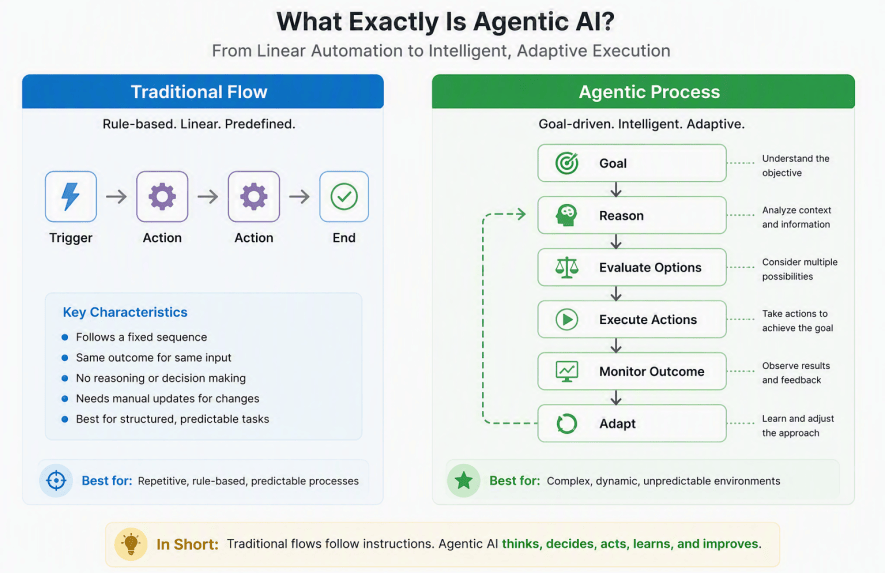
2. What Exactly Is Agentic AI?
Agentic AI goes beyond answering questions.
An agent can:
- Understand objectives
- Gather information
- Make recommendations
- Execute approved actions
- Learn from outcomes
3. Key Power Platform Innovations
AI Agent Authoring in Power Automate
Microsoft is introducing enhanced AI agent authoring capabilities alongside intelligent automation improvements and self-healing experiences. [learn.microsoft.com]
Potential benefits:
- Reduced maintenance effort
- Smarter automation
- Greater resilience
Dataverse + Work IQ
Dataverse is evolving into a foundational knowledge layer for AI-powered decision making through Work IQ and Microsoft 365 Copilot integrations. [learn.microsoft.com]
4. Architecture Considerations
This is the section where your architect expertise will stand out.
Data Architecture
Questions architects must ask:
- What data can agents access?
- How is data secured?
- What is the trust boundary?
Integration Architecture
Agents will increasingly interact with:
- Dynamics 365
- SAP
- Azure Services
- Microsoft 365
- Third-party APIs
This increases the importance of:
- API governance
- Identity management
- Observability
Operational Architecture
Organizations need:
- Agent lifecycle management
- Monitoring
- Performance analytics
- Audit trails
5. Governance Becomes Critical
With autonomous agents, governance is no longer optional.
Focus areas include:
Security
- Data access policies
- Managed identities
- Role-based permissions
Compliance
- Auditability
- Data residency
- Regulatory controls
Cost Management
- AI consumption tracking
- Copilot usage monitoring
- Resource optimization
Microsoft is continuing to strengthen governance and administration capabilities across Power Platform as AI adoption increases. [learn.microsoft.com]
6. Real-World Use Cases
Dynamics 365 Sales
Sales agents can:
- Research accounts
- Identify opportunities
- Recommend next actions
- Assist with record creation and pipeline management [learn.microsoft.com], [learn.microsoft.com]
Customer Service
Agents can:
- Classify cases
- Recommend resolutions
- Automate workflows
- Assist service representatives [learn.microsoft.com]
Internal IT
Power Platform agents can:
- Handle user requests
- Orchestrate approvals
- Execute routine administrative tasks
7. What Technical Architects Should Do Now
Immediate Actions
✅ Define AI governance standards
✅ Review Dataverse security strategy
✅ Establish agent design principles
✅ Create observability frameworks
✅ Identify suitable business processes for agent adoption
Avoid
❌ Giving agents unrestricted access
❌ Ignoring audit requirements
❌ Treating agents as simple chatbots
❌ Skipping governance discussions
Conclusion
The transition from workflows to copilots and now to autonomous agents represents one of the most significant architectural shifts in the Microsoft Business Applications ecosystem. The question is no longer whether organizations will adopt AI agents, but how effectively architects can design secure, governed, and scalable platforms to support them. Microsoft’s 2026 roadmap makes it clear that agentic AI is becoming a core capability across Power Platform and Dynamics 365. [learn.microsoft.com], [microsoft.com], [learn.microsoft.com]

Related Posts

